

DQ Type Steel Elevator Bucket Overview
DQ type steel elevator bucket is a shallow bottom bucket designed for high-speed centrifugal discharge applications. It is manufactured using a one-piece stamping process, forming a seamless and high-strength structure.
Seamless one-piece design ensures higher strength compared with welded buckets.
Manufacturing Process
Both carbon steel and stainless steel buckets are produced through a deep drawing stamping process, where each bucket is formed as a single unit without welding.
This seamless structure improves overall strength, durability, and wear resistance.
Due to the material characteristics of steel, the bucket depth is slightly lower than that of plastic buckets. As a result, the “C” dimension remains close between models such as DS1314 and DQ1314, making them suitable for similar applications.
We offer all standard sizes in both carbon steel and stainless steel. For stainless steel buckets requiring a larger “C” dimension, thicker plate material can be used to ensure the required forming depth despite its lower elongation.
Design Classification
There are two main types of stamped steel buckets:
- DQ type – shallow bottom bucket for centrifugal discharge
- DS type – deep bottom bucket for gravity discharge
This product refers to the DQ type.
Use advice
- Use for the high-speed centrifugal material discharging.
- Recommend “Z-Y”+5% as the usable capacity for engineer design.
Technical Drawing
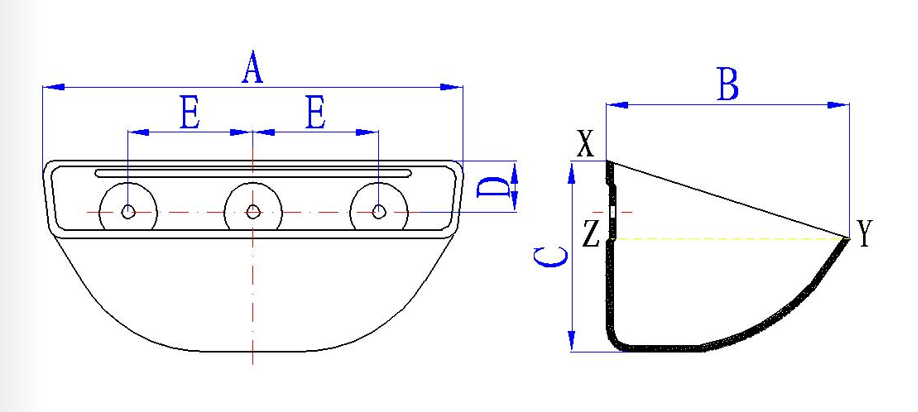
Specifications
| Model | Bucket Dimension(mm) | Mounting Holes(mm) | Thickness (mm) |
Capacity(L) | ||||
|---|---|---|---|---|---|---|---|---|
| Length A |
Proj. B |
Depth C |
Hole Centres E |
No. of Holes |
Hole diameter |
Total Level (X-Y) |
||
| DQ0807 | 90 | 75 | 48 | 50 | 2 | 7 | 1.5 | 0.2 |
| DQ1009 | 100 | 90 | 58 | 50 | 2 | 7 | 1.5 | 0.29 |
| DQ1109 | 110 | 90 | 60 | 60 | 2 | 7 | 1.5 | 0.31 |
| DQ1309 | 130 | 90 | 58 | 60 | 2 | 7 | 1.5 | 0.4 |
| DQ1311 | 139 | 112 | 60 | 60 | 2 | 7 | 1.5 | 0.62 |
| DQ1312 | 138 | 125 | 60 | 60 | 2 | 7 | 1.5 | 0.68 |
| DQ1409 | 140 | 90 | 58 | 60 | 2 | 7 | 1.5 | 0.48 |
| DQ1411 | 140 | 112 | 60 | 60 | 2 | 7 | 1.5 | 0.63 |
| DQ1511 | 155 | 113 | 62 | 80 | 2 | 7 | 1.5 | 0.69 |
| DQ1612 | 166 | 125 | 65 | 90 | 2 | 7 | 1.5 | 0.88 |
| DQ1613 | 155 | 130 | 68 | 90 | 2 | 7 | 1.5 | 1.03 |
| DQ1813 | 188 | 130 | 80 | 90 | 2 | 9 | 1.5 | 1.09 |
| DQ1814 | 183 | 140 | 98 | 90 | 2 | 9 | 1.5 | 1.23 |
| DQ1814A | 183 | 142 | 95 | 90 | 2 | 9 | 2 | 1.2 |
| DQ1914 | 190 | 142 | 88 | 90 | 2 | 9 | 1.5 | 1.36 |
| DQ2014 | 203 | 142 | 90 | 90 | 2 | 9 | 1.5 | 1.64 |
| DQ2313 | 239 | 130 | 75 | 120 | 2 | 9 | 1.5 | 1.52 |
| DQ2314 | 233 | 142 | 95 | 120 | 2 | 9 | 1.5 | 1.75 |
| DQ2314A | 233 | 143 | 95 | 120 | 2 | 9 | 2 | 1.72 |
| DQ2316 | 236 | 162 | 100 | 120 | 2 | 9 | 1.5 | 1.52 |
| DQ2316A | 238 | 162 | 100 | 120 | 2 | 9 | 2 | 2.2 |
| DQ2417 | 240 | 170 | 109 | 120 | 2 | 9 | 2 | 2.32 |
| DQ2614 | 265 | 140 | 88 | 120 | 2 | 9 | 2 | 2.32 |
| DQ2616 | 260 | 162 | 90 | 120 | 2 | 9 | 2 | 1.63 |
| DQ2813 | 288 | 130 | 85 | 100 | 3 | 9 | 1.5 | 1.88 |
| DQ2814 | 283 | 142 | 85 | 100 | 3 | 9 | 1.5 | 1.66 |
| DQ2814A | 282 | 146 | 95 | 100 | 3 | 9 | 2 | 1.9 |
| DQ2816 | 286 | 168 | 115 | 100 | 3 | 9 | 2 | 2.77 |
| DQ2817 | 288 | 178 | 100 | 100 | 3 | 9 | 2 | 3.18 |
| DQ2818 | 290 | 182 | 115 | 100 | 3 | 9 | 2 | 3.42 |
| DQ2824 | 285 | 240 | 148 | 100 | 3 | 9 | 2 | 5.09 |
| DQ2916 | 290 | 168 | 115 | 100 | 3 | 9 | 2 | 2.86 |
| DQ3016 | 308 | 162 | 100 | 100 | 3 | 9 | 2 | 2.94 |
| DQ3018 | 305 | 183 | 125 | 100 | 3 | 9 | 2 | 4.26 |
| DQ3021 | 310 | 215 | 142 | 100 | 3 | 9 | 2 | 5.31 |
| DQ3114 | 305 | 143 | 82 | 100 | 3 | 9 | 2 | 1.89 |
| DQ3118 | 315 | 190 | 110 | 75 | 4 | 9 | 2 | 3.53 |
| DQ3121 | 315 | 220 | 130 | 75 | 4 | 9 | 2 | 5.15 |
| DQ3216 | 320 | 160 | 100 | 75 | 4 | 9 | 2 | 3.28 |
| DQ3321 | 336 | 212 | 135 | 80 | 4 | 9 | 2 | 4.15 |
| DQ3325 | 340 | 255 | 130 | 80 | 4 | 9 | 2 | 9.41 |
| DQ3518 | 358 | 180 | 110 | 90 | 4 | 9 | 2 | 3.4 |
| DQ3621 | 365 | 220 | 125 | 90 | 4 | 9 | 2 | 6.61 |
| DQ3823 | 380 | 230 | 125 | 90 | 4 | 9 | 2 | 5.93 |
| DQ4118 | 415 | 190 | 115 | 95 | 4 | 11 | 2 | 5.73 |
| DQ4121 | 415 | 220 | 125 | 95 | 4 | 11 | 2 | 7.07 |
| DQ4216 | 420 | 160 | 110 | 90 | 4 | 11 | 2 | 6.08 |
| DQ4423 | 445 | 233 | 148 | 90 | 5 | 9 | 2.5 | 7.02 |
| DQ4621 | 460 | 220 | 125 | 95 | 5 | 11 | 2.5 | 8.38 |
| DQ4723 | 475 | 233 | 148 | 95 | 5 | 11 | 2.5 | 7.49 |
| DQ4626 | 460 | 260 | 195 | 95 | 5 | 11 | 2.5 | 7.58 |
| DQ5121 | 518 | 220 | 125 | 95 | 5 | 11 | 2.5 | 9.6 |
| DQ5626 | 560 | 260 | 153 | 110 | 5 | 11 | 2.5 | 11.34 |
The installation hole could be customized.
👉 Not sure which bucket fits your system?
Tell us your application or required size — we will recommend the right model within 24 hours.
Performance Characteristics
Key features include:
- One-piece stamping and forming for higher structural integrity
- Excellent abrasion resistance due to solid steel construction
- Suitable for different temperature conditions, including high-temperature environments
- Smooth surface for efficient material discharge
Applications
DQ type steel buckets are widely used in:
- Cement and construction materials
- Sand and aggregates
- Fertilizer and chemical industries
- Grain and bulk material conveying
Material Options
Available materials include:
- Carbon steel – cost-effective and strong
- Stainless steel – corrosion-resistant and suitable for harsh environments
Working Principle
The shallow bottom design enables efficient centrifugal discharge at high operating speeds, making it suitable for systems requiring fast material handling and continuous operation.
Engineering Considerations
For optimal performance, the following factors should be considered:
- Conveyor speed
- Material characteristics
- Temperature conditions
- Bucket size and spacing
For reliable system matching, DQ steel buckets can be combined with our bucket elevator components, including elevator belts, bolts, pulleys, belt fasteners, and other compatible accessories.
Why Are Stainless Steel Elevator Buckets More Expensive?
Stainless steel elevator buckets are generally more expensive due to both material and manufacturing factors:
1. Higher Raw Material Cost
Stainless steel is significantly more expensive than carbon steel, which directly impacts the base cost of the bucket.
2. More Challenging Manufacturing Process
Compared to carbon steel, stainless steel has lower elongation, making it more difficult to form during the stamping process. This increases the risk of defects such as cracking or surface imperfections.
However, they offer superior corrosion resistance and longer service life in demanding environments.
As a result, the production process typically has a higher rejection (scrap) rate, which contributes to the overall cost.
In Summary
The price of stainless steel buckets is not determined by material cost alone, but also by the increased manufacturing complexity.
However, we are able to produce all standard sizes listed, ensuring reliable supply for your application needs.
DQ Steel vs Plastic Shallow Bottom Elevator Buckets
(DQ & S Type Comparison)
| Feature | DQ Steel Bucket (Shallow Bottom) | S Plastic Bucket (Metric) | DQ Plastic Bucket (Inch Size) |
|---|---|---|---|
| Material | Carbon steel / Stainless steel | HDPE / Nylon / PU | HDPE / Nylon / PU |
| Manufacturing Method | One-piece stamping (deep drawing) | Injection molded | Injection molded |
| Structure | Seamless, high strength | Lightweight, integrated | Lightweight, integrated |
| Weight | Heavy | Light | Light |
| Strength | Very high, suitable for heavy-duty use | Moderate | Moderate |
| Wear Resistance | Excellent for abrasive materials | Good | Good |
| Corrosion Resistance | Lower (needs coating or SS) | Excellent (non-corrosive) | Excellent (non-corrosive) |
| Capacity Design | Shallow bottom, fast discharge | Optimized for clean discharge | Shallow bottom, standard DQ type |
| Size Standard | Metric sizes | Metric sizes | Inch sizes |
| Customization | Limited (mold-based) | Limited | Limited |
| Application | Cement, sand, industrial bulk handling | Grain, feed, agriculture | Grain, feed, standard conveying |
| Temperature Resistance | High temperature suitable | Medium (depends on material) | Medium (depends on material) |
| Cost | Higher initial cost, long service life | Lower | Lower |
FAQ – DQ Steel Bucket
What is a DQ steel bucket?
A DQ steel bucket is a shallow bottom steel elevator bucket designed for high-speed centrifugal discharge systems. It is commonly used in bucket elevators where fast material release and continuous conveying are required.
What are the main features of a DQ steel bucket?
DQ steel buckets feature a one-piece stamped design with a seamless structure, providing high strength, durability, and improved wear resistance compared with welded bucket designs.
What materials are available for DQ steel buckets?
DQ steel buckets are commonly manufactured in carbon steel and stainless steel. Carbon steel is suitable for general industrial use, while stainless steel offers improved corrosion resistance for demanding environments.
What applications are suitable for DQ steel buckets?
DQ steel buckets are suitable for high-speed bucket elevator systems handling powders, grains, feed, light bulk materials, and industrial products requiring centrifugal discharge.
What is the difference between DQ and DS steel buckets?
DQ steel buckets have a shallow bottom design intended for centrifugal discharge at higher speeds, while DS steel buckets use a deep bottom profile designed for gravity discharge in lower-speed systems.
Why choose a stamped steel bucket instead of a welded bucket?
Stamped steel buckets are manufactured as a seamless one-piece structure, which improves strength, reduces weak points, and provides better wear resistance compared with welded constructions.
Are DQ steel buckets suitable for abrasive materials?
Yes, DQ steel buckets offer strong wear resistance and are suitable for handling abrasive or heavy-duty bulk materials in industrial conveying applications.
👉 Not sure which bucket type fits your system?
Send us your requirements, and we’ll help you select the most suitable solution.
Related Blog:


